Versions
News
What has changed in the edition, version by version, newest first. The edition is an open beta: text, presentation, and tools are being improved continuously.
0.8 New search, new home page, new typeface 22 and 23 October 2026
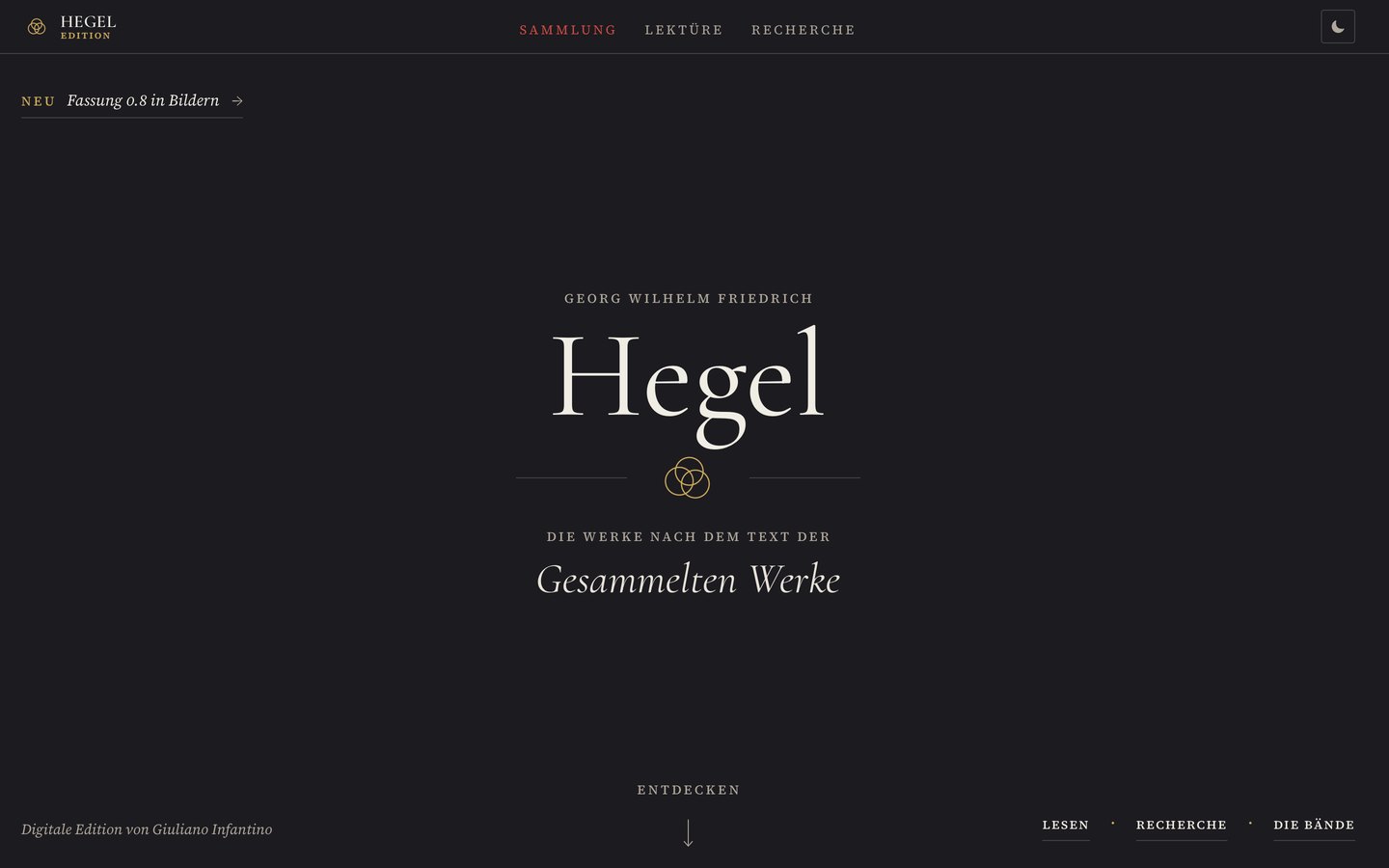 Version 0.8 in pictures →Home page, search, and reader next to version 0.77, with sliders for overlaying them.
Search
- Cited down to the line. Every passage is given with page and line of the Gesammelte Werke (“GW 12, 18.36–37”), together with the section in which it occurs, and opens in the print layout at exactly these lines. “Copy citation” copies the reference; all passages of a search can be copied as a citation list or saved as a CSV table.
- Three views. Passages, grouped by volume. Concordance: one line per occurrence, the search term in the middle, sortable by order of the works, by the preceding word, or by the following word. Distribution: how often a query hits per 10,000 words in each volume and where in the volume, from the first to the last page. A click leads to the passages of that volume or page range.
- The search language. A word now means the whole word, and modern spelling finds the historical one (Sein finds Seyn, Teil finds Theil). New are word beginnings and word endings (
dialekt*,*seyn), wildcards in the middle (ver*ung),=Seynfor exactly this spelling, the exact word sequence in quotation marks even across page breaks, proximity withNEAR/nandBEFORE/nandSENTENCEfor the same sentence, all also in German (UND,ODER,NICHT,NAH/n,VOR/n,SATZ). As you type, the field colors the query, states below how it reads it, and suggests words from the edition. - Forms. For each search term, the search shows which spellings it has found, with their frequency; each can be excluded individually.
- More text. Hegel’s own notes are searchable for the first time; main text, notes, and headings can be included and excluded individually. A passage across a page break no longer appears twice.
- First view (23 October). Without a query, the page shows only the title, field, scope, and four examples; the selection of volumes and the search language expand on demand. Title and field stay in place while searching; the views appear with the first hit.
- Faster. Instead of one large index, the page loads one file per volume. Keys:
/into the field,jandkfrom passage to passage,ccopies the citation,1to3switch the view.
Home page
- A title page (23 October). The home page begins like the title page of a volume: Georg Wilhelm Friedrich Hegel, “The works based on the text of the Gesammelte Werke,” who prepared the edition, and three ways in: Read, Search, The Volumes.
- A list of the volumes. Arranged by Early Writings, Jena, Nuremberg and Heidelberg, and Berlin; each volume with its page count, for reading and as a TEI file in the same line. The second list for the TEI files alone has been dropped.
- Key figures. Only pages with Hegel’s text are now counted, 6,630, no longer title pages and lists in addition (previously 7,095).
- Outlook as a timeline: when the remaining 31 volumes become free, from 2031 to 2045, one field per volume.
- The page is complete even without JavaScript.
Reading
- Typeface. Source Serif now in its full cut: true small capitals, old-style figures in the reading text, Hegel’s note asterisk from the typeface itself. Greek, including polytonic, comes from EB Garamond instead of a system font.
- Marginal notes. What Hegel wrote in the margin appears on wide screens next to the line to which it belongs. On narrow screens and on very dense pages it remains below the page.
- Hegel’s tables of contents are set as contents lists: dotted leaders, indentation following the structure, page numbers in a column. In GW 11, 13, 19, and 20, the numbers of the original edition lead to their place in the text.
- Title pages set centered, with the imprint in small capitals.
- Headings from the same family as the text and graded according to Hegel’s structure, from Theil and Abtheilung down to the paragraph number.
- Contents in the sidebar: ordinal marks in a column of their own, GW page on the right, deeper levels collapse and open at the current reading position.
- Typesetting: more balanced line endings, calmer hyphenation in Safari too, words in capitals within running text set as small capitals.
- Print layout. Every full line is fitted to the column individually; previously about five percent of the lines extended beyond the right margin.
- Emphasis now in three levels: italic, letter-spaced as in print, or plain.
0.77 The edition reads TEI 18 October 2026
- Reader and search now read the source TEI of each volume (TEI P5). Every volume can be downloaded as TEI-XML: on the home page and in the reader under “Data.”
- Two note anchors in GW 16 and GW 17 corrected.
0.76 GW 17 read in full for letter-spaced type 8 September 2026
- All 318 text pages of the philosophy of religion checked word by word against the page image; 96 marks corrected. The Guidelines now list GW 17 as a full count.
0.75 Letter-spaced type reassessed 6 September 2026
- All 4,159 flags from the machine check decided against the page image, plus a recall test across all 18 volumes; 235 marks corrected.
0.74 Type area and fine-tuning 2 September 2026
- Reading text limited to a calm line length, page number next to the text, headings graded, ragged-right setting on the phone. In narrow windows the print layout reduces the type size instead of rewrapping.
0.72–0.73 Smoother reading 27 August 2026
- Pages are drawn in stages while scrolling; the noticeable stutters in long volumes are gone.
0.70 18 volumes 26 August 2026
- Five new volumes, GW 18 and GW 20 captured for the first time.
0.60 Logic and Encyclopedias 20 August 2026
- Five new volumes: GW 1, 3, 11, 13, and 19.
0.50 Eight volumes, open license 13 August 2026
- Six new volumes (GW 4 to 9). Hegel’s text is in the public domain; the edition’s own contributions are licensed under CC BY 4.0.